:::

Development of Domestic Vanadium Redox Flow Battery


Published:2025-12-03  10:18

Technical Introduction】
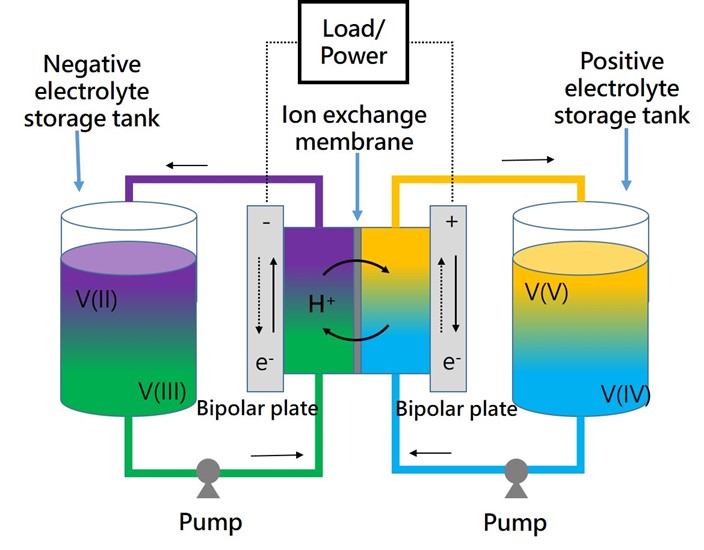
 Among energy storage batteries, vanadium redox flow batteries (VRFBs) stand out for their high safety, long service life, and strong environmental sustainability, as most of their materials can be reused or recycled. The independent configuration of power and energy makes VRFBs a key technology for energy storage systems. The key components of a VRFB are the ion-exchange membrane, carbon felt electrodes, bipolar plates, and electrolyte. During charging, electrical energy supplied by an external source oxidizes tetravalent vanadium ions at the positive electrode to pentavalent vanadium ions, while trivalent vanadium ions at the negative electrode are reduced to divalent vanadium ions. During discharge, the chemical reactions proceed in the reverse direction. Through the change in vanadium ion valence states, the system enables the mutual conversion between electrical and chemical energy, thereby achieving the processes of energy storage and release.


Fig. 1 Schematic diagram of vanadium redox flow battery.

Domestic Clamped-Type Flow Battery
The design and development of large-area clamped battery modules not only require optimization of flow field design but also demand careful consideration of the mechanical characteristics of the module assembly and the stress distribution across key materials. During the assembly process of large-area modules, improper assembly stress can cause structural deformation of materials, impairing functionality or even leading to mechanical failure. Such issues may include cracking of bipolar plates or flow distributors, thinning, wrinkling, or tearing of ion-exchange membranes, and loss of elasticity in sealing gaskets. These failures can reduce stack performance, shortened service life, and cause electrolyte leakage. Consequently, the fabrication of large-area modules poses greater challenges to manufacturing processes, assembly techniques, and testing resources, yet represents a necessary endeavor for advancing industrial applications and research development.
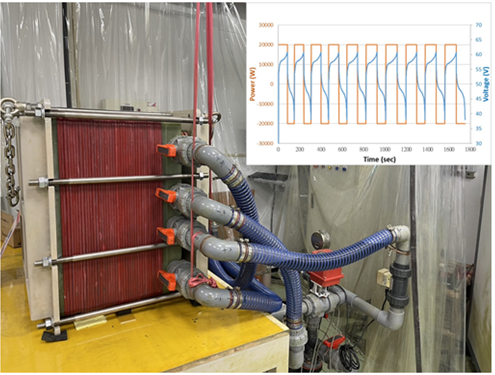
In this approach, carbon felt electrodes are processed via plasma treatment, which imparts high hydrophilicity. As a dry-process method, it is well suited for scalability and ease of assembly in future production. Coupling etched flow channels on the carbon felt electrodes with those on the frame plate greatly enhances electrolyte distribution and improves its  inflow and outflow within the stack. This promotes uniform electrolyte dispersion across the entire carbon felt electrode, increasing the contact area between the electrolyte and electrodes, thereby improving electrochemical reactivity. Ultimately, this leads to a significant improvement in charge–discharge energy efficiency. Performance evaluation of the battery module under constant-power operation (Figure 2) was conducted with a stack having a reaction area of 2,565 cm², comprising 38 cells with a rated discharge voltage of 48 V. Test results indicate that, under a 20 kW discharge condition, the energy efficiency exceeded 70%. This demonstrates that the integration of plasma-etched carbon felt electrode flow channels with the frame plate flow channels enables maximized stack performance in the developed large-area battery modules.


Figure 2. Domestic Clamped-Type Flow Battery Modules and Performance Testing at Laboratory

Innovative Compact Vanadium Redox Flow Battery
Conventional redox flow batteries are typically assembled using bolt-fastened clamping structures, with numerous sealing components integrated into the frame plates to achieve leak prevention. However, uneven force distribution at the fastening points often compromises or even fails the intended sealing function. Stress concentration may cause brittle fracture of graphite plates, damaging the internal structure of the battery stack and thereby reducing its designed performance.
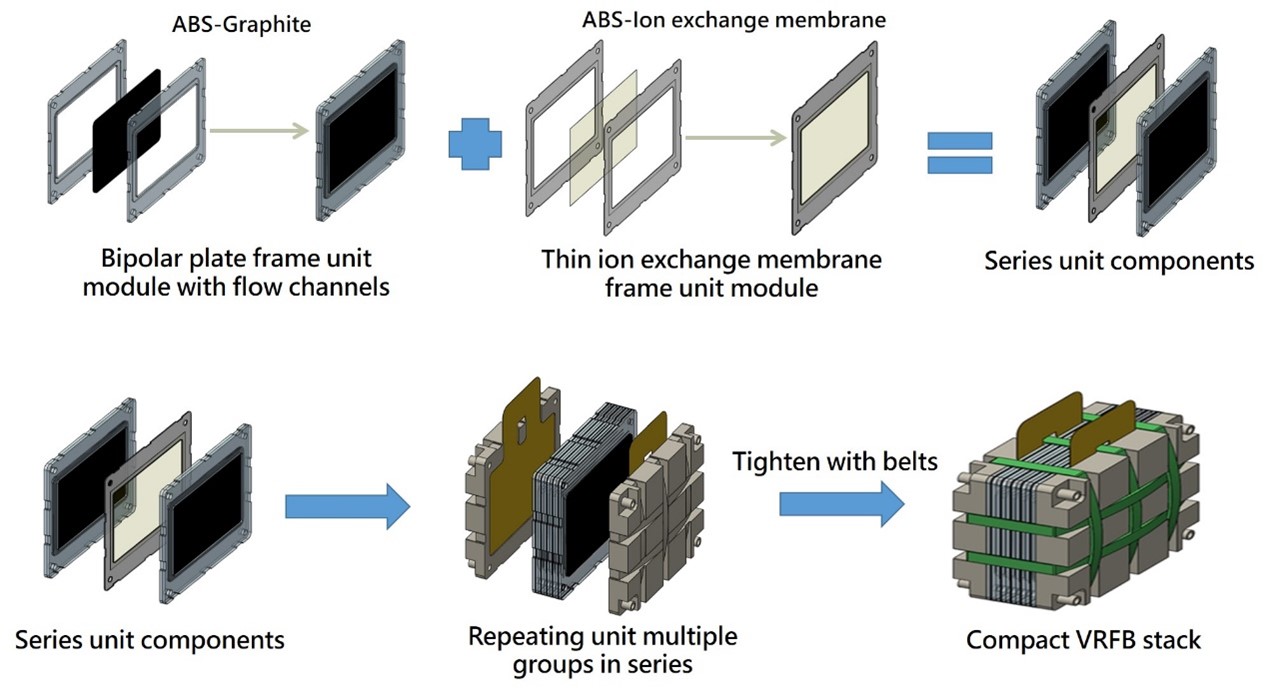
To expand the application potential of vanadium redox flow batteries (VRFBs) across diverse usage scenarios, efforts have been directed toward developing a new stack architecture: the “banded” or “compact” stack design. This configuration is specifically tailored for space-constrained environments, offering a lightweight, thin, and compact battery stack system. By adopting thin bipolar plates, integrally formed flow-field modules, and high–energy-density electrode materials, the design not only significantly reduces weight and volume but also maintains competitive power density performance. With these innovations, volumetric power densities on the order of 70 kW/m³ are expected to be achievable.


Figure 3. Schematic Diagram of the Innovative Compact Flow Battery Module Assembly

 
【Project Planning/Technical Applications】
The project is planned as a behind-the-meter (BTM) safe energy storage and green energy integration technology development initiative, with the positioning of flow battery technology defined as follows:
1. Development of key technologies for domestically manufactured battery modules and energy storage materials.
2. Application of behind-the-meter safe energy storage modules in renewable energy sites.
The initiative aims to integrate domestically developed safe energy storage modules with renewable energy fields, testing the near-commercial performance of domestic modules and establishing optimal operational control strategies. Demonstration will begin at green energy storage sites such as campuses, providing a foundation for future community and residential applications, thereby accelerating the development of Taiwan’s emerging behind-the-meter energy storage industry.

【Future Development】
    The Institute will align with the national strategy on energy storage and green energy by advancing the commercialization of domestically developed behind-the-meter safe energy storage modules, fostering the localization of the energy storage industry. We will extend the application of these technologies to various renewable energy sites, thereby accumulating system deployment experience, securing core technological capabilities, enhancing module performance, and reducing costs. These efforts will help decrease reliance on imported technologies, accelerate industrialization, and strengthen Taiwan’s competitiveness in the global energy storage market.

【Contact Information】
Name: Ning-Yih Hsu
Tel:03-4711400 Ext.5501
E-mail:nyhsu@nari.org.tw