:::

The Research on High-Temperature Steam-Electrolysis Module Modeling and Dynamic Simulation of Hydrogen Production


Published:2025-12-03  10:59

【Technology Introduction】
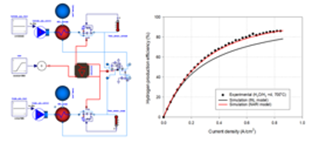
High-temperature steam electrolysis (HTSE) is an electrochemical technology capable of converting thermal and electrical energy into hydrogen energy, offering higher energy conversion efficiency compared to other conventional electrolysis methods. In the study, we have successfully utilized the HYBRID simulation tool developed by Idaho National Laboratory to establish the HTSE electrochemical module in NARI. Through simulation analysis, there are some key results shown below.
  • Electrochemical performance:
    • For single-stack HTSE module, when input electrolysis power reaches 166 W(or current density at 1.0 A/cm²), the electrolysis efficiency can achieve approximately 90.69% (LHV).
    • When steam utilization rate is controlled at 79.49%, the hydrogen production rate reaches 6.22×10⁻⁴ mole/s.
  • Heat flow and temperature analysis:
    • The average temperature of HTSE stacks rise to 754 °C when operated at current density 1.0 A/cm², indicating the stacks at exothermic state. The result
is beneficial for designing heat-recuperation devices and use of residual thermal energy.
  • When the HTSE stacks are operated under thermally neutral conditions, the corresponding current density is 0.32 A/cm², with an operating voltage close to 1.30 V.
  • Potential industrial application:
    • In a scaled-up scenario where the input power reaches 52 MW, at a current density of 1.0 A/cm², the hydrogen production rate of HTSE stacks can reach 0.435 kg/s.
 
【Project Planning/Technical Applications】
The research objective is to develop a prototype HTSE system. Through the simulation analysis, we can predict the performance of real stacks, including hydrogen production efficiency, heat-flow distribution and gas composition. The simulation results are consistent with those from real stacks, indicating the accuracy of the HTSE model. This outcome will serve as the foundation for the design of the prototype system, significantly reducing the duration required for hardware development and verification.
  • Integrated modeling and simulation:
    • At present, the thermal management module is capable of being integrated with the HTSE stack module for integrated simulation analysis, using parameters based on the current experimental conditions. The results indicate that the outlet steam temperature from the heat exchanger reaches 627 °C, while the exhaust gas temperature from the stack reaches 760 °C. This residual heat can potentially be utilized in integration with other modules (such as reactors or organic Rankine cycle generators), to achieve maximum utilization of hybrid energy.
  • Figure 1. HTSE module and integrated simulation.

Fig.1 HTSE module and integrated simulation.

【Future Deployment】
The future work will focus on the mass and energy balance calculations of HTSE systems, to design a high-conversion efficiency prototype system. A dynamic HTSE module will be developed to conduct real-time dynamic response analysis, addressing the instability of hybrid energy sources, such as renewable energy.
In the integrated energy architecture, the HTSE dynamic module is scheduled for cyber-physical integration testing with other hardware components such as reactors, or turbine generator, to investigate the optimization of heat and power dispatch. This technology not only enables the most efficient energy dispatching methods but also provides critical technical support for Taiwan’s pathway to net-zero carbon emissions.
 
【Contact Information】
Name: Liang-Wei Huang
Tel:03-4711400 Ext.6765
E-mail:i13501350@nari.org.tw