:::

High-efficiency, low-carbon-emission kW-scale SOFC stack technology


Published:2026-06-26  10:59

【Technical Introduction】
The overall performance and operational stability of an SOFC stack are primarily determined by cell material design, manufacturing process consistency, and the integration level between stack architecture and sealing technologies. Current domestic research and development efforts mainly focus on single cells or small-scale modules, while comprehensive process technologies covering cell fabrication, stack assembly, and kW-scale stack demonstration still underdeveloped. This project establishes a complete process framework from cell fabrication to stack assembly. In-house fabricated anode-supported SOFC cells are employed to complete multi-cell stacking and assembly, followed by high-temperature operation and power generation testing for performance validation.
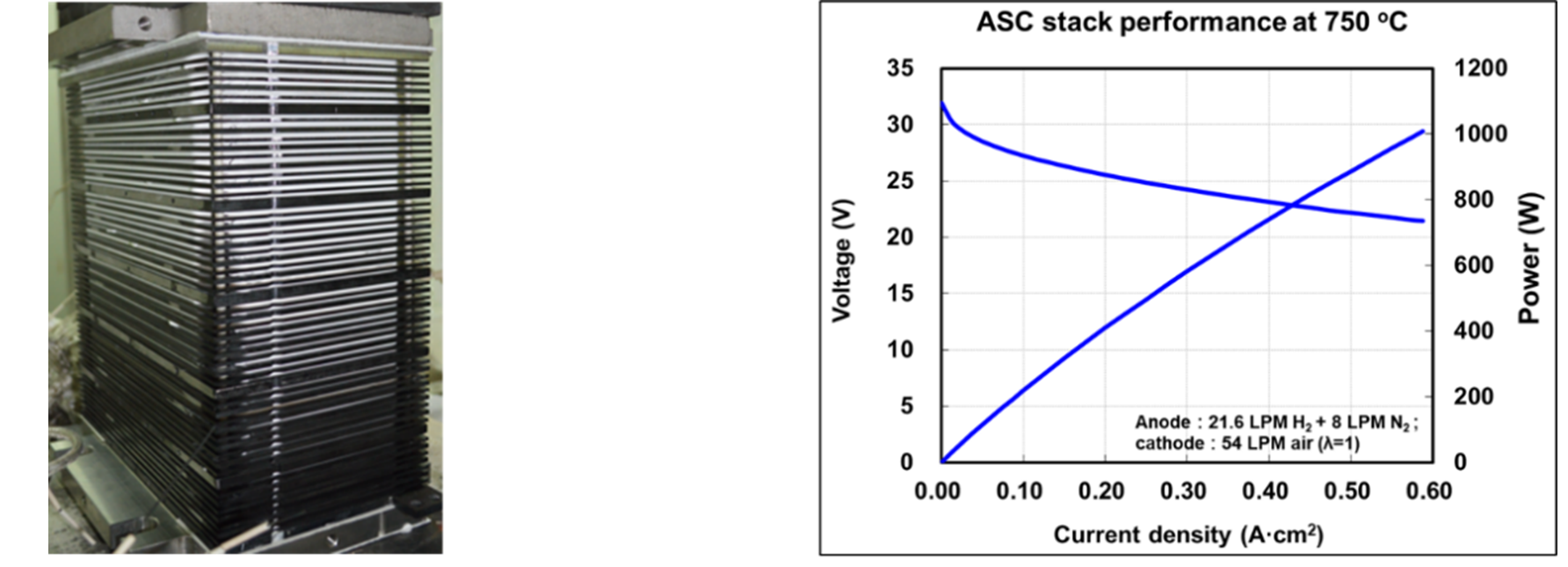
The fabricated anode-supported cell (ASC) stack was evaluated at an operating temperature of 750 °C. Under open-circuit conditions, the measured stack voltage was 31.96 V, corresponding to an average single-cell voltage of over 1.18 V, indicating good consistency in cell fabrication and stack assembly. Under load conditions, the stack achieved an operating current of 47 A and a maximum output power of 1,007 W, successfully demonstrating kW-scale SOFC stack power generation. The resulting stack performance indicates stable power output characteristics, confirming that the developed technology has reached a mature level in terms of cell fabrication processes, stack structural design, and high-temperature operational stability. These results establish a critical technical foundation for subsequent stack scaling and system integration. The self-made kW-scale stack and its performance are shown in Figure 1 and Figure 2, respectively.

Figure 1. Self-made kW-scale stack                                          Figure 2.Performance of the self-made kW-scale stack                                                     
【Project Planning/Technical Applications】
    This project aims to developing a kW-scale SOFC stack and conducts technical planning at three levels: cell fabrication, stack design, and system validation. At the cell level, material compositions and process parameters for the fuel electrode, electrolyte, and air electrode are established. Through slurry preparation, coating, and high-temperature sintering processes, SOFC cells with high gas tightness and favorable electrochemical performance are fabricated, followed by structural and electrical characterization.
    At the stack level, the design and fabrication of interconnects, sealing materials, and stacking structures are carried out to ensure gas tightness, mechanical integrity, and efficient current collection under high-temperature operating conditions. Multi-cell stacking and assembly are completed, followed by stack operation tests to evaluate output power, efficiency, and long-term operational stability.
    The developed technology is applicable to distributed power generation systems, backup power supplies, and future hydrogen-, and synthetic fuel-based power generation applications. It is particularly suitable for applications requiring long-duration, stable power supply, and high energy utilization efficiency. By establishing comprehensive process development and validation capabilities, this work also provides a technical basis for the modularization and commercialization of SOFC systems.

【Future Development】
    Future work will build upon the established kW-scale SOFC stack technology and further advance toward higher power density and extended stack lifetime. Optimization efforts will focus on improving cell material durability, thermal cycling stability, and sealing reliability. In parallel, system-level integration technologies will be incorporated to develop SOFC power generation modules suitable for practical deployment, thereby enhancing overall system efficiency and operational flexibility. Additionally, the extension of SOFC technology to reversible solid oxide cells (rSOC) and synthetic fuel production processes is planned, strengthening integration with hydrogen energy systems, carbon cycling, and renewable energy sources. Through these efforts, an advanced high-temperature electrochemical energy technology platform will be progressively established to support the national energy transition and the development of low-carbon technologies.
 
【Contact Information】
Name: Chien-Kuo Liu
Tel:03-4711400  Ext. 6775
E-mail: ckliu2@nari.org.tw