【Technical Introduction】
Dry storage technology for nuclear fuel is a method used to store used nuclear fuel, primarily after it has been water-cooled in the reactor and transferred to long-term storage facilities. After nuclear fuel has been used in a nuclear power plant, the spent nuclear fuel must first be cooled in a spent fuel pool for several years until its decay heat and radiation levels decrease, before being moved to dry storage facilities.
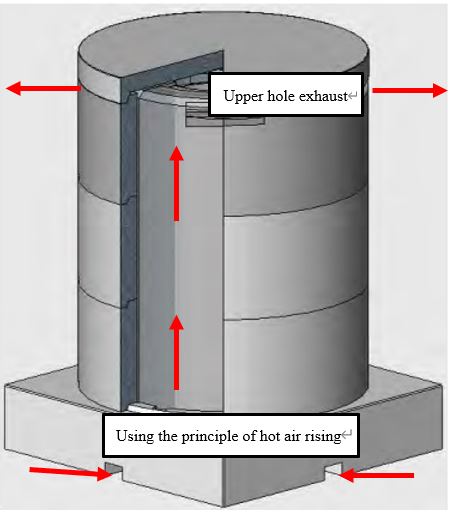
The core concept of dry storage is natural convection cooling (as shown in Figure 1), where environmental air flow carries away the residual heat generated by the fuel without requiring an external powered cooling system, offering greater stability and safety.
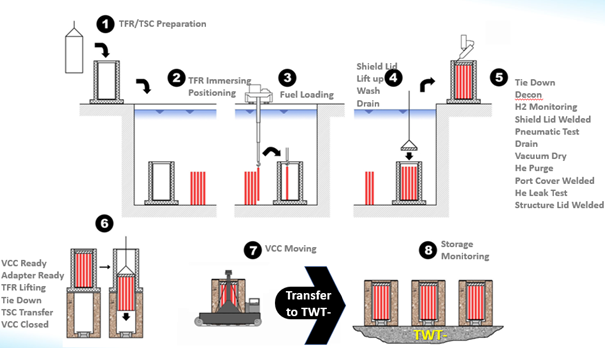
Currently, Taiwan is actively promoting the application of dry cask storage technology. Our institution has successfully completed two sets of dry cask storage hot tests and has officially entered the operational license application stage. The dry cask storage technology covers multiple key components (as shown in Figures 2), including the lifting and loading of storage containers, ensuring their long-term safe operation.
Our institution will continue to invest in the advancement of dry storage technology and talent development to ensure the competitiveness of storage systems, as well as enhance the safety and efficiency of nuclear energy backend management, ensuring the stable storage and proper management of nuclear fuel.

Figure 1. The principle of natural heat convection

Figure 2. Dry storage operation process
【Project Planning/Technical Applications】
In alignment with the national energy transition and nuclear energy backend management policies, our institution has improved dry storage technology to effectively ensure the safe management of spent nuclear fuel. Through a natural convection cooling mechanism, the technology allows stable heat dissipation inside the storage containers, maintaining the containers within a safe temperature range.
Our institution has successfully completed two dry storage hot tests and supported Taiwan Power Company in the operating license application process. In May 2025, the Nuclear Safety Commission granted the operating license, officially marking the beginning of storage operations. All related activities are currently proceeding smoothly. The application of dry storage technology ensures that, once nuclear fuel is transferred from the fuel pool to the storage facility, it remains in a safe state without relying on cooling water, reducing operational burdens and enhancing overall nuclear backend management efficiency.
Furthermore, our institution will continue to invest in technological optimization and talent development to ensure that the dry storage system meets international standards, further improving the safety and stability of nuclear fuel storage, and providing reliable support for the nation’s energy transition and nuclear development.
【Future Development】
In the future, our institution will actively promote the further development and application of dry storage technology, aiming to play a more significant role in the application of dry storage at other nuclear power plants in Taiwan. In addition to continuously optimizing the safety and stability of the dry storage system, we will also conduct in-depth planning for "indoor dry storage," striving to become a leader in the development of dry storage technology in the country.
We will focus on enhancing the flexibility and adaptability of the dry storage system to achieve safer and more efficient storage solutions. Furthermore, our institution will strengthen technological research and development and talent cultivation to further enhance competitiveness, seeking more opportunities for collaboration in the nuclear backend management field.
【Contact Information】
Name:Pan, Po-Cheng
Tel:03-4711400 Ext.3752
E-mail:pan0228@nari.org.tw |
| |
|
|
|
|
| |
|
|
|