:::

Key Technology for the Management of Radioactive Spent Ion-Exchange Resins – Volume Reduction and Stabilization


Published:2026-06-29  14:52

【Technical Introduction】
This technology provides an integrated treatment method for radioactive spent ion-exchange resins (hereinafter referred to as spent resins), including cation, anion, and mixed-bed resins.
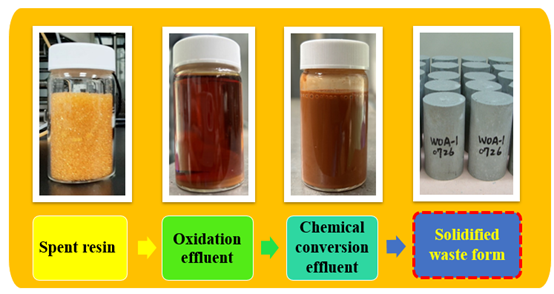
The core process applies Wet Oxidation to decompose the organic polymer structure of the spent resins. Through oxidative mineralization under controlled temperature and pressure conditions, the resins are transformed into inorganic aqueous species suitable for subsequent stabilization.
Following oxidation, a chemical conversion step is implemented to condition the oxidized solution. Sulfate ions present in the solution are precipitated via chemical reaction (e.g., formation of barium sulfate), ensuring compatibility with cementitious solidification. The precipitated products remain within the system and are incorporated into the final waste form.
The conditioned solution is then subjected to high-efficiency solidification, where radionuclides are immobilized within a stable cementitious matrix, forming a chemically and mechanically durable solidified waste form.
During the conversion stage, ammonia may be generated as a secondary by-product. In this patented system, off-gas containing ammonia is treated using a copper-based catalytic decomposition unit operating below 450 °C, converting ammonia into nitrogen and water vapor. The system is designed to prevent hydrogen generation and ensure operational safety.

Figure 1. Stabilization process of radioactive spent resins

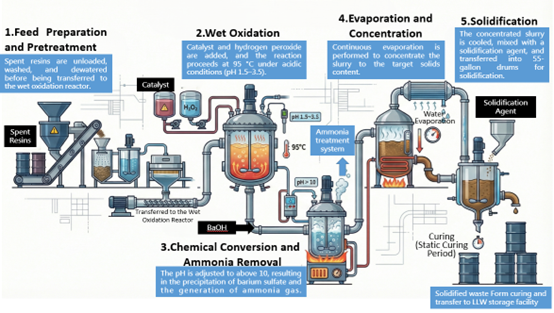
Figure 2. Process flow for stabilization of radioactive spent resins

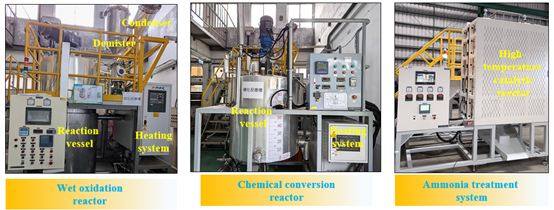
Figure 3. Demonstration treatment system for radioactive spent resin stabilization

【Project Planning/Technical Applications】
According to IAEA technical guidance, radioactive spent ion-exchange resins contain organic polymers that may degrade under long-term radiation exposure, potentially affecting waste form integrity. Due to their organic nature, direct cementation without pretreatment may lead to swelling, gas generation, or reduced mechanical strength.
Historically, untreated resins have been stored in drums at interim storage facilities. However, increasing storage constraints and decommissioning demands necessitate technologies capable of both volume reduction and long-term stabilization.
To address these challenges, the proposed system integrates three major treatment stages (Figure 2):
1. Wet Oxidation
The organic polymer matrix is decomposed and mineralized into an inorganic aqueous phase.
2. Chemical Conversion
Sulfate ions in the oxidized solution are precipitated via controlled chemical reaction to improve compatibility with cement-based solidification systems.
3. Solidification
Radionuclides and precipitated products are immobilized within a cementitious matrix to achieve long-term stabilization.
A dedicated demonstration-scale treatment system for radioactive spent resin stabilization has been established (Figure 3). Operational testing indicates that the final waste volume can be reduced to less than one-third of the original volume, while maintaining structural integrity of the solidified waste form.
Additionally, the integrated ammonia catalytic treatment system enhances overall process safety and engineering completeness, supporting practical deployment considerations.

【Future Development】
This technology integrates wet oxidation, chemical conversion, and solidification into a coherent treatment platform and has been granted Taiwan Invention Patent No. I839848.
Future work will focus on:
l  Expanded operational data under varying feed compositions
l  Optimization of reaction parameters and energy efficiency
l  Long-term leaching and durability assessment of solidified waste forms
l  Engineering design refinement toward modular and scalable deployment
Through continued technical validation and collaboration with domestic and international partners, the technology is positioned to support radioactive waste volume reduction and stabilization efforts within the back-end of the nuclear fuel cycle, particularly in support of decommissioning and long-term waste management programs.
 
【Contact Information】
Name: Hsieh, Hsien-Te
Tel:03-4711400 Ext. 5620、5817
E-mail:ted@nari.org.tw