:::

AI-Driven Precision Diagnosis of Atherosclerosis: Next-Generation Imaging Agent Gallium-68-APD and Lesion Localization and Grading Decision System (ADSS)


Published:2026-06-26  10:46

【Technical Introduction】
 Cardiovascular disease caused by atherosclerosis is the leading cause of death worldwide. Literature indicates that lesion sites show a high concentration of activated macrophages carrying the chemokine C-X-C receptor type 4 (CXCR4). Based on the CXCR4 antagonist TIQ-15, National Atomic Research Institute (NARI) has designed a novel atherosclerotic PET diagnosis (APD) contrast agent using artificial intelligence simulation technology. The chemical structure of this drug has been granted patents in Taiwan (2022), Japan (2023), the United States (2024), and the European Union (2025). The research results have also received significant recognition, winning first place (Excellent Award) in the Basic Research category at the 2021 Society of Nuclear Medicine Annual Meeting in Taiwan, and consecutively winning the 2023 National Innovation Award for "Top Ten Highlight Technologies" and the 2024 National Innovation Excellence Award. The technology has also been invited to share its findings at several leading domestic conferences.
 
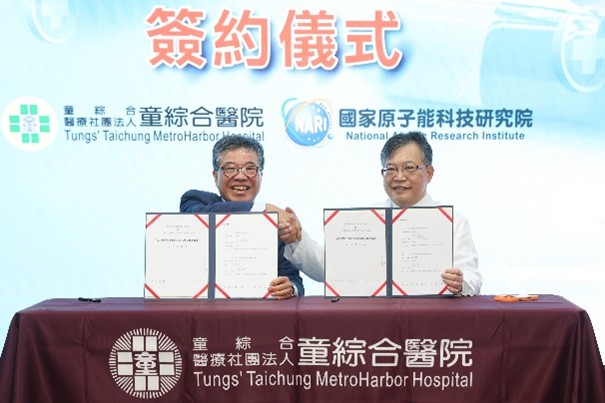
Regarding safety, Good Laboratory Practice (GLP) toxicity testing has confirmed that no toxic reactions were observed even when administered at doses exceeding 220 times the human level. Currently, three batches of the drug have been produced in compliance with PIC/S GMP standards, and modules 1 to 4 and the Investigator’s Brochure (IB) have been completed according to the eCTD format. It has passed the IRB review at Tungs' Taichung MetroHarbor Hospital and has signed MOUs with numerous teaching hospitals in Taiwan (Figure 1).


Figure.1 Signed MOU with Tungs' Taichung MetroHarbor Hospital

【Project Planning/Technical Applications】
Current clinical cardiovascular angiography faces several limitations: Fluorine-18-FDG easily interferes with myocardial function and lacks specificity for coronary artery lesions; Fluorine-18-NaF is mostly used for detecting mid-to-late stage calcification and is difficult to diagnose unstable plaques. Our institute's Gallium-68-APD has the following technological advantages:
 
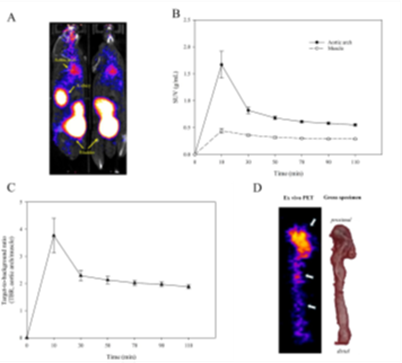
1. High specificity and sensitivity: In ApoE-/- mouse angiography experiments, the drug can accurately accumulate at the lesion site within 1 hour, with a lesion-to-background ratio (TBR) superior to the currently internationally clinical trial drug Gallium-68-Pentixafor.
 
2. Rapid metabolism: The drug can be rapidly excreted from the body via the kidneys and bladder, reducing the radiation dose to the patient.
 
3. AI Decision Support System (ADSS): Developed in collaboration with industry, academia, research, and medical teams, based on the Taiwanese open-source web medical image browser (Bluelight).
 
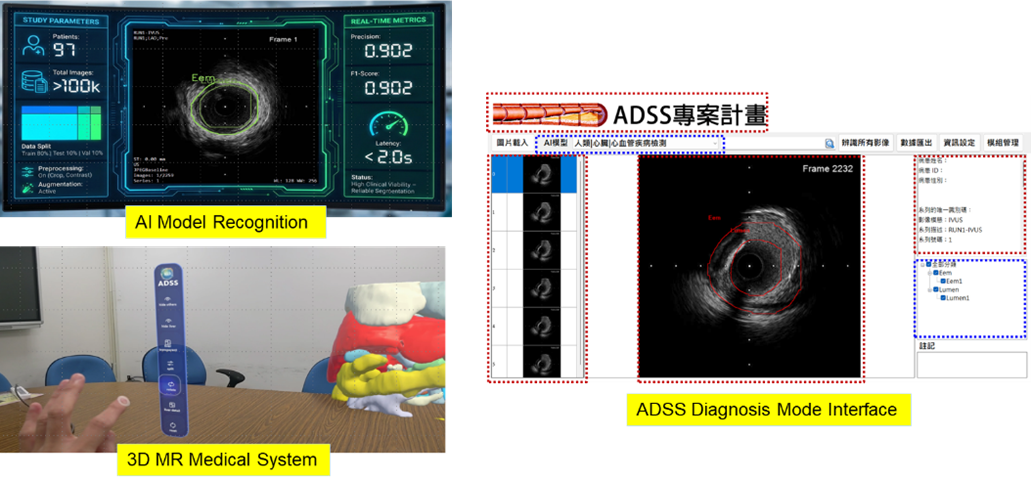
4. Precise Grading and Localization: Through expert labeling and AI model training, the system can accurately identify lesion areas, perform 3D localization, and provide expert-suggested sclerosis grading indicators.
 
5. Advanced Imaging Technology: Integrating the latest commercially available 3D Mixed Reality (MR) technology, medical teams can view 3D lesion images through a head-mounted display, applicable to preoperative communication, intraoperative assistance, and postoperative follow-up.


Figure 2. ApoE-/- model mice PET/CT imaging and time-activity curves

This study also cooperated with the engineering institute, industry, academia, and medical teams to develop an artificial intelligence-assisted atherosclerosis lesion location and grading decision support system (ADSS). The system core program was developed using Taiwan's open source WEB medical imaging browser system (Bluelight), which has clinical experience in domestic medical institutions. In conjunction with the cardiology medical team, the atherosclerosis imaging data of different sclerosis programs were used by experts to mark the lesion area, and at the same time, the sclerosis degree grading index was defined to provide reference samples for artificial intelligence learning. After AI training, an accurate and effective model will be established and built into the system to provide AI identification of atherosclerotic lesions in original images. The identification results will be able to accurately mark the atherosclerosis area, 3D positioning, and expert recommended indicators for the degree of atherosclerosis. This system will be designed with relevant modules that can be linked to the hospital system, provide report printing functions, and print reports based on relevant chart information identified by AI in combination with patient data, providing them to the medical team for evaluation. This system uses the latest global commercial 3D MR technology to display the AI training recognition results through a head-mounted display and present the 3D images of the atherosclerotic lesions through a 3D MR display platform, providing the medical team with preoperative communication, intraoperative assistance, and postoperative tracking. (Figure 3)


Figure 3. Medical AI recognition, assisted diagnosis UI and 3D MR presentation

【Future Development】
Cardiovascular disease is the leading cause of death globally, particularly for vascular obstruction caused by unstable plaques. Our hospital has planned a complete commercialization pathway:
 
1. Clinical Trial Implementation: The Phase I/IIa human clinical trial at Tungs' MetroHarbor Hospital passed the IRB review in December 2025, and the TFDA review comments are currently being responded to.
 
2. Logistics and Globalization: APD has established a terminally sterilized liquid dosage form. Hospitals can directly label and use the product after washing out Ga-68 from the generator, without being restricted by half-life logistics, which is beneficial for global promotion.
 
3. Big Data and Smart Diagnosis: We plan to establish a symptom classification database specific to the Taiwanese population to conduct longitudinal studies to achieve preventative and early warning effects.
 
4. Commercialization and Certification: We are promoting the technology transfer of the ADSS system and TFDA medical device registration to improve the service level and international competitiveness of medical institutions. According to WHO data, cardiovascular disease will cause 23.6 million deaths by 2030. APD can be used to diagnose lesions at all stages of the body, and its radiation dose is only 2.8% of that of traditional thallium-201. Our institute will focus on patenting and promoting this technology in the high-value European and American markets, hoping to improve human health and well-being through early diagnosis and efficacy tracking.
 
【Contact Information】
Name: Chien-Chung Hsia Ph.D
Tel:03-4711400  Ext. 7159
E-mail:hsiacc@nari.org.tw